



The more we know, the sooner we can end breast cancer.
Advancements in early detection and personalized treatment are in reach, and with your help we can make breast cancer an illness, not a life-threatening disease.
RAISE
MORE



We’re Breast Cancer Canada. And we need your help. To do more. Fund more. The more money we raise, the more time researchers have in the lab.
Every action counts. Every dollar matters.
If you don’t think it will make a difference, we have the science to prove it does.
PROgress Tracker
PROgress Tracker Breast Cancer Registry is a knowledge-based research study collecting Patient Reported Outcomes (PRO) data through the use of questionnaires from diverse experiences of breast cancer participants from diagnosis, treatment and surveillance over the course of time. People diagnosed with breast cancer at any stage, during any period of their journey will complete questionnaires four times a year to share their individual experience and outcomes of breast cancer across Canada. The data will be collected into a database for researchers and clinicians to analyze large population responses and learn more about breast cancer issues and improvements from the patient perspective.
Progress CONNECT
Research has shown us that there are over 50 types of breast cancer. Progress CONNECT is an online tool designed by Breast Cancer Canada to provide patients with information specific to their type. Patients work through a series of questions requiring their pathology results. The information shared generates a personalized report outlining their type of breast cancer and potential treatment options that may be appropriate based on the stage and biomarkers status. The goal is to help patients have thoughtful discussions with their treating oncologist by providing evidence-based information relevent to their stage and biomarkers.
Our path to progress
For the last three decades, you’ve known us as the Breast Cancer Society of Canada. But with a disease that is ever evolving, we have also evolved.
We remain the only organization in Canada laser focused on breast cancer research because we believe in building on the outstanding progress that’s been made. We see the power in what we do, and will continue to work to highlight the unwavering passion of precision oncology and personalized medicine.
We are Breast Cancer Canada and we champion:
- Diversity by creating a basis of ethnically diverse breast cancer patients in clinical trials
- Acceleration by driving Canadian research from the lab directly to the clinic with precision oncology
- Innovation by applying research methodology that utilizes emerging technology
- Patient leadership by developing Patient Reported Outcomes (PROs) for breast cancer in Canada
- Connection by rapidly expanding the network of research and sharing of data to support design and running of novel Canadian clinical trials
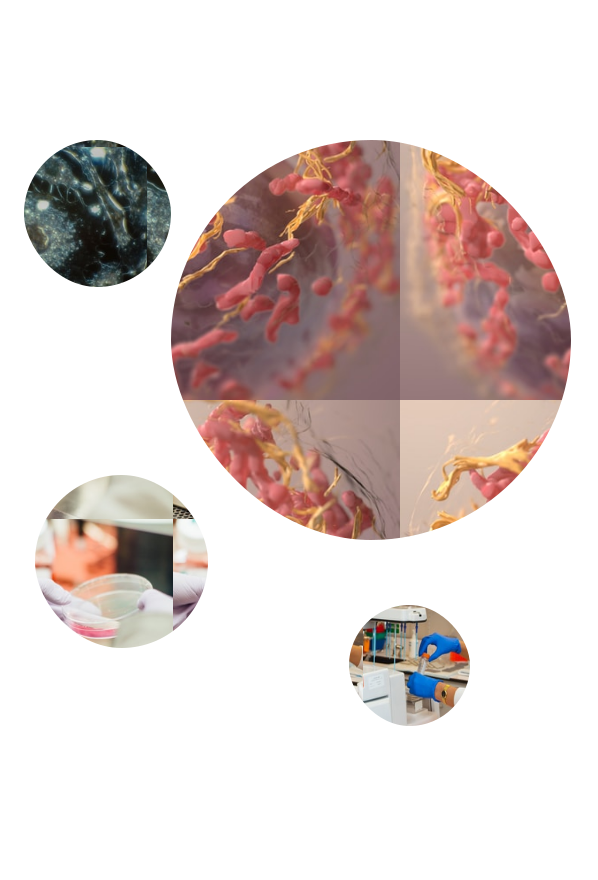
Patient-focused precision oncology
Most people don’t realize that breast cancer isn’t one disease – it’s over fifty – each needing specific treatments. That’s what precision oncology is – personalized treatments that match the right plan with the right person at the right time.
Thanks to the generous support of our donors, Breast Cancer Canada continues to fund precision oncology research, encouraging collaboration among physicians and researchers. With research, the end is possible.

Know more stories
There are so many beautiful stories of survival to share. Stories from mothers, daughters, sisters, friends and researchers across the country.
Each experience with breast cancer is unique. And while their courage is infectious, our goal is to raise the funds needed to make this the last chapter of research needed to end breast cancer, so there are no more stories like this to read.
Get Involved
The more money we raise, the sooner we can end breast cancer. Join us on our mission to end breast cancer.